

STORING & SORTING THE CUTTINGS
✁✁✁ The cut collection.
Whether in boxes, folders, as a jumble of notes or ironed in foil, is a frequently asked question on many channels and today I present my tried and tested method of storage.
Hanging it up.
Reinforcing and hanging.
This method requires a bit more space, but unlike the alternatives, it offers a clean and gentle way to work with the sheets even after multiple uses, without any loss of corners or edges. The stencil paper also lies more firmly on the fabric and is easier to handle.
I'd like to give you a little guide to working with sewing patterns. Even though printing patterns at home offers a certain flexibility, it's advisable to prepare your favorite pattern thoroughly and effectively so you can enjoy it as often and for as long as possible.
In plain terms, this means that a pattern is adapted to the individual's figure, and after sewing, a decision is made as to whether it is finalized with these changes and added to the collection.
If we proceed systematically and incorporate the parameters into daily use, not only will a new structure of order emerge, but also an important parameter will come around the corner with a smile:
TIME.
Because those who organize their things properly and structure them as clearly as possible will save time, be able to quickly find their patterns and precisely define adjustments.
We start by removing the cut and applying a clean label.
01 ♠ Paper selection for tracing
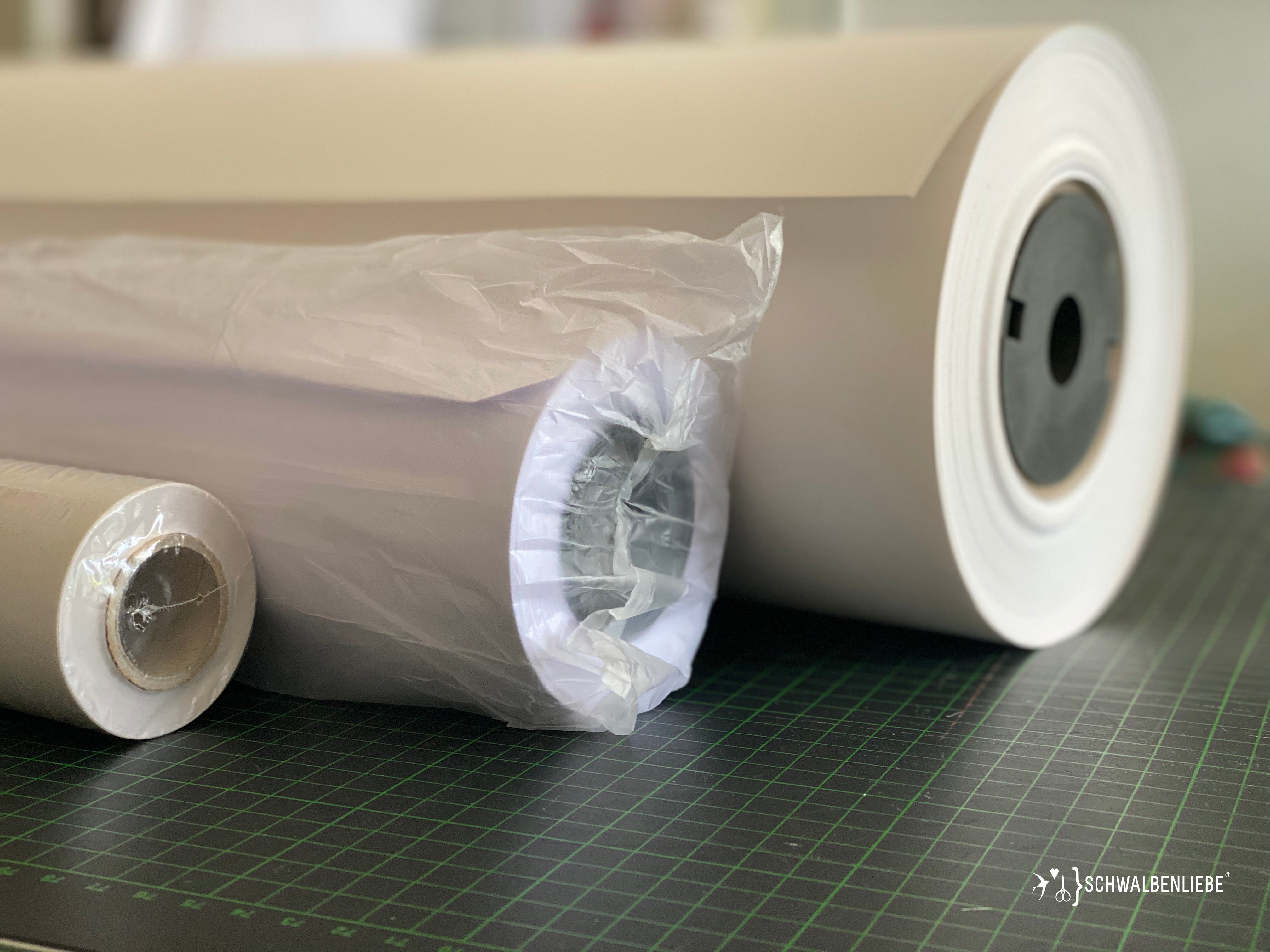
If you're tracing from a pattern sheet, I recommend using high-quality drawing paper on a roll. I personally prefer working with Schoeffler tracing paper with a weight of 40 g/m².
02 ♠ Add adjustments
Every body is unique, so purchased and copied patterns usually need to be adjusted to the individual's body. A swayback can cause wrinkles in the back, a full bust needs its space, and freedom of movement in the shoulder and arm area also depends on how the pattern-making technique was incorporated.
What really matters:
Note down all changes and transfer the final information to your pattern at the point where they were made. So, if you've increased your armhole depth by 1 cm, note this in small print on the corresponding section of your pattern. This is essentially the transition to point 3, because taking notes is key to understanding the pattern later on.
03 ♠ Labeling & Marking
Once the pattern is taken, I note down all the important information on the pattern and draw in the grainline.

The following information makes sense:
a. Section name, project name & version number
b. Size or sizes, if jumped
c. Section Name | Extra Information & Quantity
d. Fraction, number of cut pieces
e. Fit class if known
f. Information on seam allowance

04 ♠ Transferring drawing paper to stencil paper

Many manufacturers offer stencil paper, but I personally prefer working with the one from Schoeffler. It comes in a 60m roll with a weight of 250g and is very sturdy, and its handling is truly excellent .

05 ♠ Final. Hanging up the cuts.

To hang up the patterns, I now clip curtain hooks onto the patterns and hang them on a Grundal shelf from Ikea.
Alternatively, clip hooks also work well.
If a suitable shelf isn't available, I also find the solution of a single clothes rail on the wall very charming. Or a taut rope beneath a hanging shelf? The important thing is that the cuts have enough space so they can be hung neatly.
Of course, A4 prints can also be reinforced in the same way after they have been glued together. The advantage here is that most of the information is already there and you only need to add any necessary changes.
_
It looks pretty good, doesn't it?
It is also space-saving and sustainable.
For my new studio, I chose a taut curtain cord from the fabric stash, which I'll hang quite high. Of course , Murkel will always have to use a chair to help her with the patterns, but the labels make it easy to identify everything, and that brings us back to today's magic word:
TIME.
Because with the time gained, I can once again sniff my roses in the garden, be with my children, talk shop with my husband, or go scootering with my huskies.
No matter where you hang your patterns, whether on a rope high above your heads, on a clothes rack in the middle of the room or under a shelf, it takes some work initially, but in the long run it really brings order to your pattern collection and, above all, it is crease-free, clean and can be used many times with the template paper. 
Perhaps you will feel like gradually reworking your collection and will appreciate the rather old-school way of storing your bows.
Good succeed!
❥ ❥ ❥
#sewingpattern #studio #organization #mainstreamissoldout